Tuesday, December 20, 2011

Paper Platypus and Other Adorable Origami

Every year the American Museum of Natural History decorates a giant tree with origami based around a specific theme.  This origami tree is covered with a wide array of different animals both living and extinct ranging from dinosaurs to lions and tigers and llamas. 

Origami Tree Natural History Museum 2009
Yes, that is an origami platypus!!!
It is amazing to see how many different shapes can be created from folding a single square piece of paper.  Just about any imaginable animal can be formed through a complex series of folds.

Here is my attempt at holiday origami.  The fox is my favorite.  If you want to create your own fox, a tutorial can be found here.  


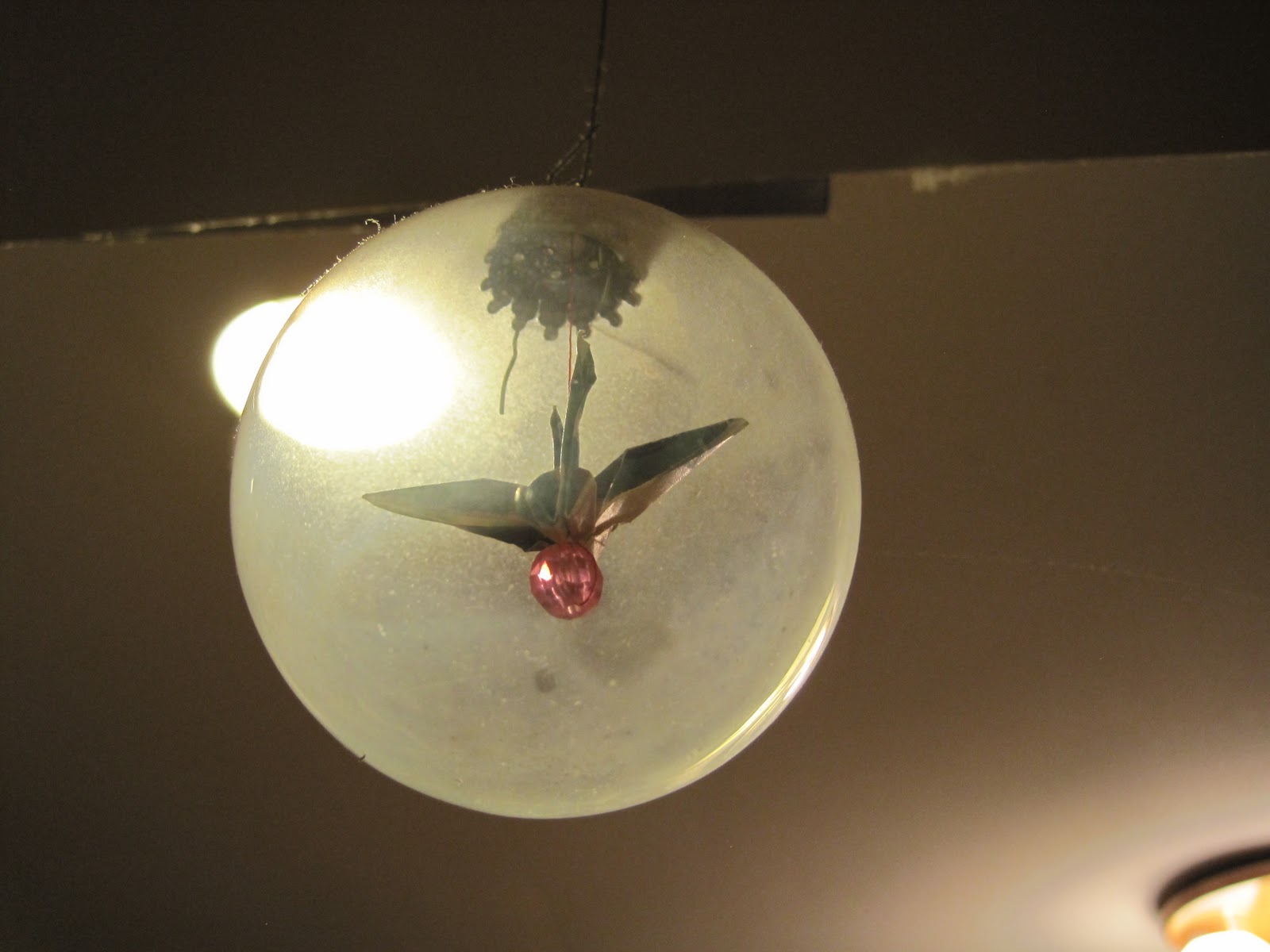
If you are looking for holiday gift ideas, this origami crane ornament is adorable and can be hung on the tree for the holidays or displayed year round as cute glass decoration.  I don't remember where the clear glass balls came from, but I'm sure they can be bought at craft stores.  The cranes were made out of small squares that I cute from wrapping paper.  Aside from that, you need a tiny piece of thread and any medium size bead and you can make your very own ornament.

Crane in a bubble
To make the ornament I folded tiny origami cranes that would fit inside the glass balls.  The cranes need to be small so that they can fit through the opening in the ball.  To attach the crane to the ornament I used a needle to sew the thread through the top of the body of the crane.  I then feed the sting through the opening in the bottom of the body of the crane and strung the bead on the string.  Next I threaded the needle back through the body of the crane and tied the sting so that the crane would remain seated on top of the bead.  After that, I inserted the bird and the bead into the glass ball.  In some cases I had to squish the crane a little to fit it in.  I kept the wings folded next to the body of the crane till it was inside the ball.  Then I pulled up on the sting so that the wings would spread out as they were pushed against the top of the glass ball.


Once the crane was inside the ball I took the opposite end to the sting and I wound the string through the silver attachment on the glass ball.  When the crane was hanging in the correct place in the ball I clipped the silver top back in place.  Since the silver attachment is above the desired location until it clips into place you must be sure to take this into account when placing the crane.

Have fun folding!

Monday, December 19, 2011

You've got a Lizard in your Ear

The mammalian skull offers a unique opportunity to discuss evolutionary adaptation and and the difference between homologous and analogous features.  When examining the fossil record, the separation of modern "mammals" is demarcated by a change in joint connecting the mandible to the skull.  Prior to this point the connection was formed by two separate bones, the quadrate and the articular.  In birds and lizards and other non-mammalian genera these bone are separate from the body of the mandible and the cranium.  In mammals, the mandible articulates directly with the temporal bone of the cranium, without any intermediary bones.

Meow?
So, are the quadrate and articticular bones present in mammalian skulls?  In fact these bones are conserved, but they serve a different function in the mammalian skull.  Homologous features are the same physical structure between different taxa.  While the features are morphologically the same, they may preform different functions in different organisms.  On the other hand, analogous features have the same functional uses, but arise from different anatomical structures.  In mammals, the incus and the maleus bones of the ear are homologous to the quadrate and articular, respectively.  Although the bones are the same anatomical structure, in mammals, the bones preform a major role in hearing rather than jaw movement.  Instead, the articulation between the temporal and the mandible is analogous to the quadrate/ articular connection in non-mammals, since it has taken on the functional job of connecting the mandible to the cranium.


Transitional fossils have been found showing organisms with a jaw articulation between the temporal and mandible as well as the quadrate and articular.  The change in the jaw articulation is likely due to several different factors.  First of all, reduction in size of the articular and quadrate made them more sensitive to vibrations and improved the hearing capabilities of these organisms.  Organisms with better hearing were better able to avoid predators and reproduce.  Thus, the continued reduction of the ear bones was adaptively advantageous.  Alternatively, the reduction of the jaw joint limited the size of the jaw and the bite strength of the organism.  In this case, a larger joint was more advantageous because it allowed the organism to consume larger prey and also subdue the prey more efficiently.  Thus, decoupling these two functions, allowed mammals to benefit from both increased hearing and jaw size.

Be Aware, It's a Bear!!!
If life ever gets you down, just remember, you have a tiny little lizard jaw joint working in your ear. :)

Sunday, December 18, 2011

Tatted "Tooth Fairy" Masks

One holiday project that I have been working on is a series of tatted masks.  The white one is completed, the red one needs a little more embellishment, and the eyes on the black one are not finished yet.


Originally I had planned to display the three in a shadow box with the title "Disguises of the Tooth Fairy" as a gift for my dad (he's a dentist :)), but it got a little crushed on the plane ride home.  I will have to see if I can find a new piece of glass at the craft store tomorrow.  Aside from being crushed, I think the combination of the masks makes a cool piece of artwork.  While I can make tatted and crocheted things for my mom and sister to wear, it is a little harder to come up with things for my dad.  But I figure he could display it as an art piece at his office or somewhere at home.

Tooth Fairy Fashion
My dad is very patient and able to do extremely detailed counted cross stitch, so hopefully he will think the intricate lace and beaded details are neat.  For the white and black masks I used the pattern provided by Totusmel on Instructables.  She also has many amazing tatting patterns on her blog, along with tutorials how to tat using a needle.  Here is one of her designs that I replicated because I thought it was amazing.  I was impressed with the way she alternated the three different colors to create a bracelet of interwoven rings.

Infinity in shades of lavender
Eventually I hope that I will be able to design my own tatted patterns, but right now I am pretty good at recreating designs that I see.  I have begun tatting a different mask out of several motif designs, so it will be interesting to see how it comes out.

Saturday, December 17, 2011

Ties That Bind

There would I find a settled rest,
while others go and come;
no more a stranger or a guest,
but like a child at home.

-Psalm 23, para. Isaac Watts (1674-1748)

Is it strange  that someone with almost no religious training has several biblical passages memorized?  Maybe not, since many of the old songs and musical arrangements that we learned in chamber choir were based on religious texts or ideas. This particular excerpt is from the end of an arrangement that we sang my senior year of high school.  While I don't recall most of the song, this part of the piece always stuck out as memorable.  Rather than any sort of divine, otherworldly experience, heaven is expressed in warmth and comfort of coming home.  The sense of truly belonging somewhere, seen through the innocent, unjaded eyes of a child.  As depictions of heaven go, this is definitely one of my favorites.

Even though I am a "grown up" now, I still love the thought of going home and being surrounded by my family.  I miss my parents and siblings and I am excited to be flying home for the holidays.  Most places you visit, you usually the need to be on your best behavior, to be entertaining and engaging.  But home is a place where you can just be.  Family sees you at your best and your worst and they still love you.  You don't always agree on things or even like each other, but the bonds of family endure.

DNA.  Deoxyribonucleic acid.  Lots of time little nucleic acids bonded together into a double stranded helical pattern.  Replicating over and over to produce the blueprint for each structure in the body.  It is almost incomprehensible to think that humans share 99.5% of their DNA with chimpanzees, and yet each human has a unique DNA profile that can be distinguished from all other humans.  DNA is both individualizing and encompassing, as is separates (distinguishes) the individual human from their contemporaries while simultaneously connecting humans to all other living organisms on earth.  In this image, a little girl returns home with the skeletal remains of her sister.  Unbreakable invisible bonds of DNA link the girl to what is left of her sister's bones, even though the recognizable features of flesh have been obliterated by decomposition.


DNA offers a powerful tool for identifying individuals and identifying those who we are closest to genetically.  In this case, the little girl is reunited with the remains of her relative combining the shared experiences and memories of family members with the shared genetic inheritance.  In this way, the siblings are able to return home together.


No more a stranger or a guest.

Friday, December 16, 2011

Granny's Garden Permutation

I just completed the blue series for the granny square blanket I have been working on.  I'm not sure if you can tell from the picture, but so far no color sequence has been repeated for this blanket.  I have three shades for each color, as well as black and white.  So for each set I am using a combination of black and white with two of the color shades.  Following that pattern I can make 24 different square permutations for each set of four colors, given I don't ever repeat a color sequence.  I had already made three sets of 24 squares using the purple shades, but now I have also completed three sets of blue squares.  I have one completed set of 24 green squares, so my next task is to crochet the remaining two series of 24 square.  Stitching some simple statistics into my project keeps me entertained and I really like that none of the squares have been duplicated so far.  Each one is unique, even though it shares the same color scheme and underlying pattern as the rest of the squares. 

Once I finish all three sets of 24 for each of the three colors I will have a total of 216 granny squares.  I can't wait to finish the green and see all of them laid out together!

168 Lovely Little Grannies :)
I haven't decided how I want to lay out the blanket after I finish making up the squares.  I don't know if they will look best grouped by the outer bordering color or if I should block them in sets of 24, or even mix and match color combinations.  I am also considering making a much larger blanket and doubling all three color sets.  That would mean the total number of squares in the blanket would be 432.  I wonder how many stitches that would be. 

If I double the entire series of squares, then each square would have a single matching counterpart.  Kind of like a giant game of memory. 

Granny Square Garden
I am really happy with the color combinations.  They are all so pretty, and the different shades all seem to go really well together.  The pattern I'm using for the actual square can be found on Attic 24's blog.  She does some beautiful crochet work and offers many different patterns with helpful tutorials, so if you are learning how to crochet you should definitely check out her blog.

Thursday, December 15, 2011

Firefly Jars

One thing that I miss about the summer months is seeming fireflies light up the early evening hours.  Tiny beacons against the darkening night sky that make you want to smile.  So when I came across a tutorial on how to make firefly jars, I was hooked.  I gathered up some old glad jars (the one on the left used to hold pickles and the one on the right was originally contained tomato sauce, yum), a paint brush and a few bottles of different colored glow-in-the-dark paint.  In a few minutes I was able to whip up my own illuminated bottles.  I was expecting the paint to really glow when I turned out the lights (based on the pic in the tutorial), but I was disappointed that the dots I painted were almost invisible in the dark.  After that I abandoned firefly jar project, and just used them to hold random stuff around my house. 

So pretty!
But two months later I was hunting through the clearance Halloween goodies and discovered a miniature black light.  Once back home I began investigating the new and exciting world of UV radiation and what should I happen to notice, but the firefly jars!!!  Apparently, the UV wavelength caused the pigment in the glow in the dark paint to illuminate.  So there you have it, firefly jar awesomeness.  :)

My mission to add a little firefly cheer to the winter continues with another design project I have started.  Here is a rough sketch of some fireflies. 


I think a series of lanterns filled with illuminated insects would be fun.  If I make it as a stencil then I could even use the glow-in-the-dark paint to add a second dimension that would only be visible with the black light.  Maybe even a secret coded glowing firefly message. 

Wednesday, December 14, 2011

Donatin' the Bloods

Today I stopped by Medic because I was pretty sure that I was able to donate again.  It turns out today is exactly two months since my last donation so I was able to give blood.  :) 

When I first started giving blood I used to freak out before going because I'm a chicken when it comes to needles.  I think donating is starting to desensitize me because I don't panic before they are about to stick me anymore.  I still don't like needles, but I'm not afraid of them.  Hooray for conquering fears!

Pumping out a pint

Awesome bright orange bandage!!

Every time I donate blood, punnett squares pop into my head.  I can't help it, I'm a nerd.  My blood type is A+ (either AA+ or AO+), so assuming that my parents are actually my parents that means they must be either A and A or A and O, and if they are A, they could either be AO or AA, since A masks the expression of O.  Also, one or both of them must have be positive for the Rh factor, since that is also the dominant allele in this situation, and I am +.  Furthermore, my siblings must be A or O, though they could be either + or - since - is recessive and either of my parents could be heterozygous (1 positive and 1 negative allele) for the Rh factor gene.  These results are not surprising since O+ is the most common blood type in the US, followed by A+.

Hopefully my blood will help someone in the future.   You never really know when you might find yourself in a situation where you need a transfusion, so it's cool that we can rely on the help of complete strangers for something so essential as blood.